
Established 1901
WIDGE Timeline
A chronological account of the Wankswell Institute for the Development of Graphic Expression.
More than a century of research, preservation, linguistic development and occasional strategic obscenity.
↠ 1901 ↞
THE WIDGE FOUNDATION
The Wankswell Institute for the Development of Graphic Expression (WIDGE)
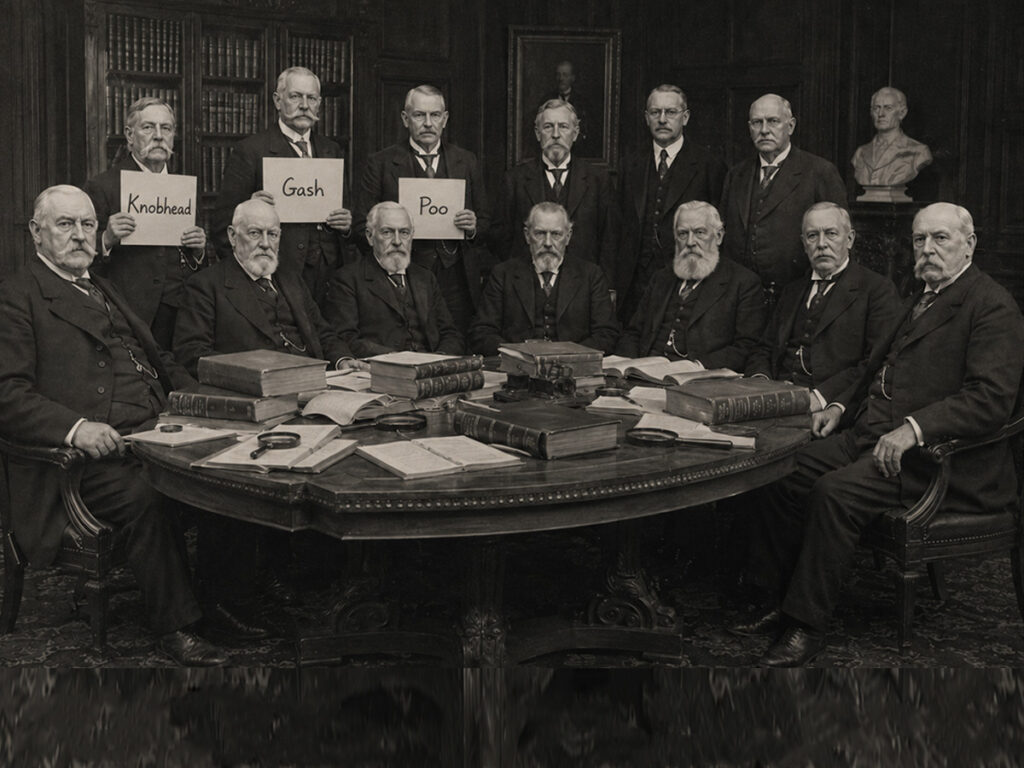
The WIDGE Foundation was founded in 1901 by Percival Richard Wankswell, who had become convinced that Britain devoted far too much effort to preserving great literature and nowhere near enough to preserving the language people actually used when they hit their thumb with a hammer. Established as an independent charitable trust, WIDGE was dedicated to the study, preservation and advancement of what its founder described as Graphic Expression: the colourful, inventive and occasionally appalling side of the English language.
↠ A PRECISE SCIENCE ↞
THE CASE FOR PROFANITY
Percival believed that profanity, when properly deployed, was not a sign of ignorance but of precision. A well-placed obscenity could communicate disappointment, admiration, pain, disbelief or contempt more efficiently than an entire paragraph of respectable prose. The Institute therefore set about documenting regional dialects, collecting unusual insults and encouraging the continued evolution of English through carefully managed linguistic research. It was an unusual charitable objective, but no more unusual than many Victorian philanthropists, and considerably cheaper than building another museum.
↠ FIELDWORK ↞
A NATION DOCUMENTED
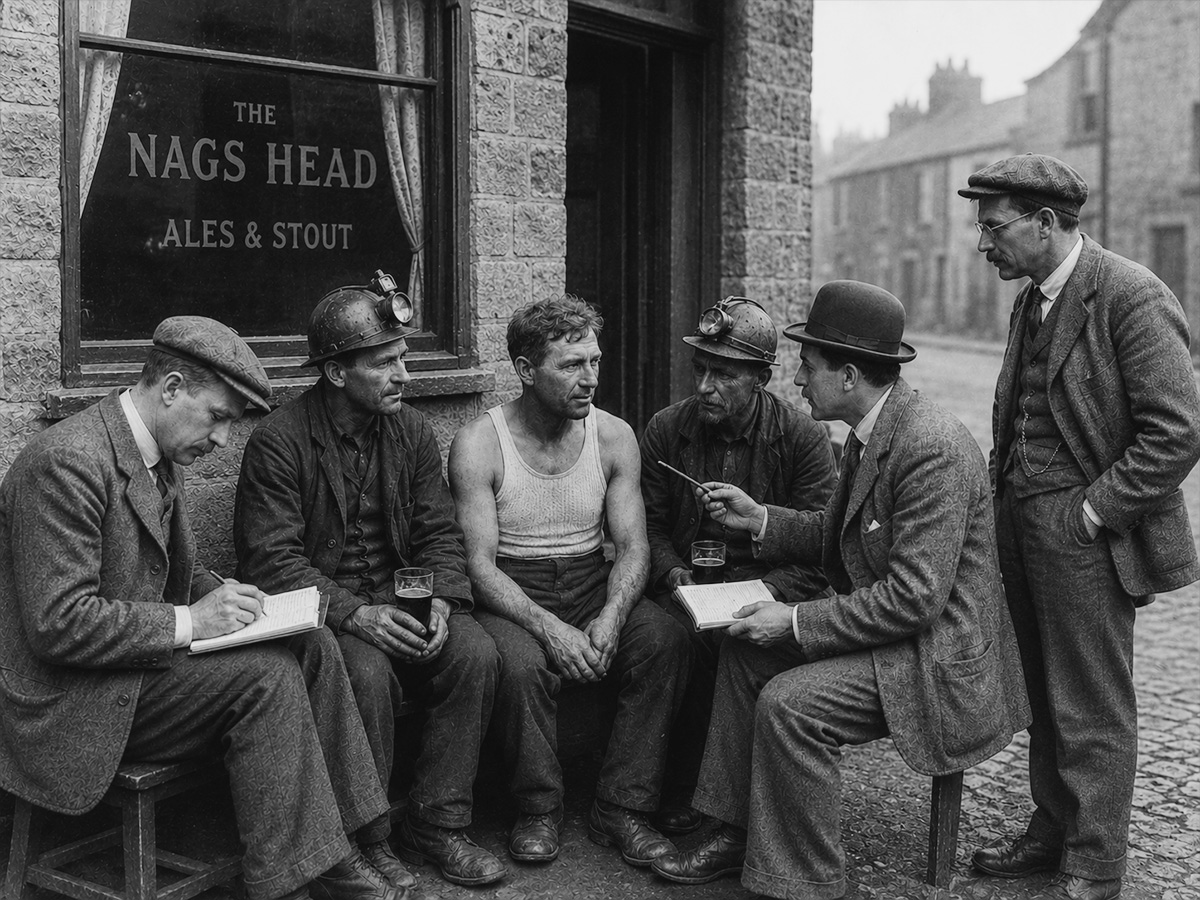
Researchers travelled throughout Britain recording expressions from docks, factories, public houses, livestock markets and cricket pavilions. Every phrase was meticulously catalogued according to its origin, historical significance, grammatical structure and likely effectiveness. Yorkshire alone generated enough material to justify three full-time archivists and one part-time therapist. Several villages insisted they had invented words which neighbouring villages maintained had always belonged to them. WIDGE diplomatically concluded that everyone was equally offensive.
↠ LINGUISTIC DEVELOPMENT ↞
INVESTING IN ENGLISH
Although best known for preserving existing language, the Institute maintained that English deserved continued investment. Where obvious gaps in the national vocabulary were identified, specialist committees were convened to explore possible improvements. Most projects attracted little public attention. Others became mildly controversial. The trustees’ decision to spend £750,000 developing the word clunge remains the subject of occasional correspondence.
↠ 1914 ↞
THE WAR OFFICE CALLS
The Institute’s first and only brief involvement in national affairs came during the opening months of the First World War. Somebody at the War Office, apparently aware that Britain possessed a learned institute devoted entirely to offensive language, enquired whether more imaginative abuse might have value in lowering enemy morale. WIDGE responded with characteristic enthusiasm, producing a memorandum entitled Recommendations for the Weaponisation of Graphic Expression Under Active Service Conditions. The report contained pronunciation notes, projected morale ratings and a small number of carefully researched German-language insults.
↠ PSYCHOLOGICAL WARFARE ↞
THE KAISER MEMORANDUM
The most celebrated recommendation alleged, in spectacularly offensive terms, that the Kaiser’s preferred pastime involved using mouldy bratwursts as marital aids while the recipient’s father calmly consumed what the Institute politely described as “posterior sauerkraut”. The committee regarded the phrase as a masterpiece of psychological warfare, praising its vivid imagery, familial scope and relentless escalation. Field reports later suggested that British soldiers struggled to pronounce it quickly enough before being drowned out by machine-gun fire. German prisoners interviewed after the war generally agreed that the grammar was dreadful.
↠ THE ARCHIVE ↞
STALE OR MOULDY?
The episode occupied little more than a few weeks of the Institute’s history, but it has remained one of its most frequently requested archive exhibits. Visitors may view the original annotated draft, complete with committee amendments in blue ink debating whether the bratwursts should be merely stale or specifically mouldy. The matter was settled after six votes, two abstentions and one strongly worded letter from a trustee who believed the adjective unnecessarily weakened the rhythm.
↠ THE TWENTIETH CENTURY ↞
QUIET SCHOLARSHIP
For the remainder of the twentieth century WIDGE quietly returned to its normal work. It expanded its archives, funded academic research and published respected reference works on regional vulgarity, occupational swearing and the gradual migration of insults between neighbouring counties. One department exists solely because somebody once remarked, “There must be a better word than bollocks.” It has occupied the same corridor ever since.
↠ TODAY ↞
INDEPENDENT, OFFICIALLY
Today, WIDGE remains entirely independent of Rude Pantry, although the two organisations have always enjoyed a warm relationship. WIDGE officially denies influencing the company’s product names, while Rude Pantry officially denies asking for advice. Neither position has ever been subjected to particularly close examination.
↠ THE LEGACY ↞
GRAPHIC EXPRESSION ENDURES
More than a century after its foundation, the Institute continues to fulfil Percival Wankswell’s original ambition: that the English language should never become dull, that imaginative vulgarity deserves proper scholarship, and that, every so often, civilisation benefits from a committee of impeccably dressed academics arguing for an entire afternoon about the military value of a mouldy bratwurst.